Guides
Stopping Wage Garnishment & Bank Levies
If your paycheck or bank account is being taken, you may still have options. Bankruptcy can often stop wage garnishment and many bank levies fast after a case is filed, but the exact rules depend on your state, the type of debt, and your timeline.
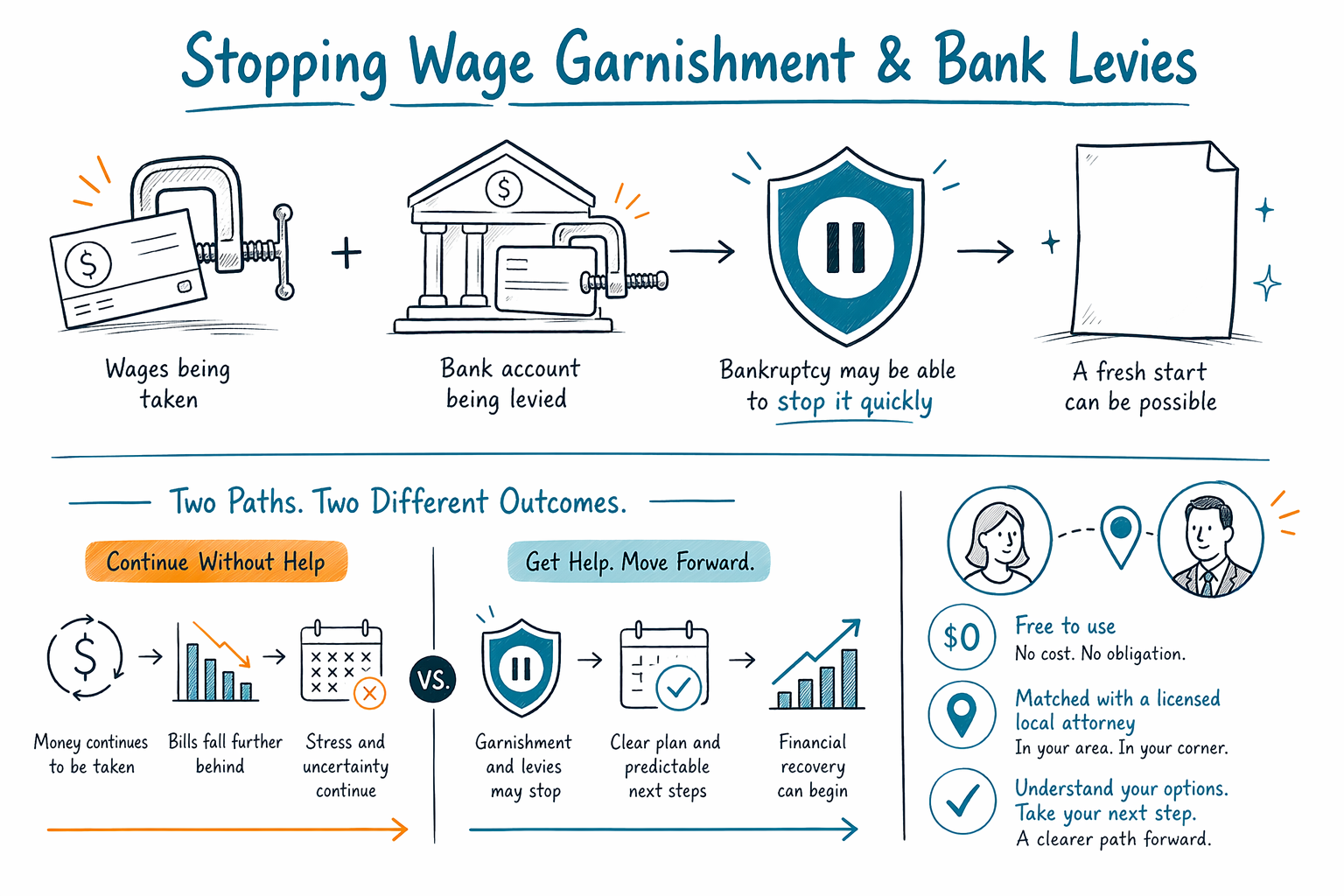
What wage garnishment and bank levies mean
A wage garnishment is when money is taken from your paycheck because a creditor, debt collector, or government agency has legal authority to collect a debt. A bank levy or bank freeze is when money in your bank account is frozen or taken. For many people, this starts after a lawsuit and judgment, but not always.
These actions can feel sudden and frightening. You may be trying to pay rent, buy food, or keep up with a car payment, and then part of your income disappears. You are not the only person facing this, and needing help does not mean you failed.
What can happen next depends on who is collecting and what kind of debt it is. Credit card judgments, medical debt judgments, taxes, child support, federal student loans, and overpayments can follow different rules. That is one reason it helps to speak with a licensed bankruptcy attorney in your area before waiting too long.
How bankruptcy can stop garnishment or a levy
When a bankruptcy case is filed, a legal protection called the automatic stay usually begins right away. In many cases, that stay pauses most collection actions, including wage garnishments, bank levies, collection lawsuits, and foreclosure steps. This is one of the main reasons people look into bankruptcy when debt has become impossible to manage.
That said, bankruptcy does not undo everything automatically. Money already taken from a paycheck may or may not be recoverable. Money already removed from a bank account may be harder to get back, depending on timing and local practice. If your paycheck is about to be garnished or your account has been frozen, time matters.
The stay also has limits. Some actions can continue, and some debts are treated differently. For example, child support and alimony collection often continue despite a bankruptcy filing. Some tax matters and other government collections may also follow special rules. Bankruptcy can be powerful, but it is not a magic reset for every problem.
If you are not sure whether Chapter 7 or Chapter 13 fits your situation, you can review bankruptcy services or learn about the main bankruptcy chapters.
When it helps most — and when it may not
Bankruptcy may help if you have a wage garnishment from credit card debt, medical bills, personal loans, old utility bills, repossession balances, or other unsecured debts you cannot realistically repay. It can also help some people who are behind on a mortgage or car loan and need time to catch up, especially through Chapter 13.
Chapter 7 is often used when income is too limited to repay much debt and the person qualifies under the means test and other rules. Chapter 13 is often used when a person has regular income and needs a payment plan, such as to catch up on mortgage arrears, car payments, or certain taxes over time. Whether you qualify, and which chapter makes sense, depends on your full situation and on state and district rules.
Bankruptcy may not solve the whole problem if the garnishment is for child support, alimony, most recent income taxes, many court fines, or debt based on fraud. Most student loans also usually survive bankruptcy unless a separate and difficult legal standard is met. Outcomes depend on the facts of the case. An attorney can explain what bankruptcy may stop now, what debt may remain later, and whether another option could fit better.
What to do quickly if your wages or account are being taken
If your pay is being garnished or your bank account is frozen, move quickly but carefully. Waiting can mean more money is taken. Guessing can also make things worse, especially if you transfer money around or ignore court papers.
- Save every notice you have: the garnishment order, court papers, bank freeze notice, collection letters, and recent pay stubs.
- Write down basic facts: who is collecting, what court is involved if any, when money was first taken, and when the next paycheck is due.
- Do not send account numbers, Social Security numbers, or detailed financial account information through a matching form. CleanSlate Match only needs contact information and a general sense of your situation.
- Ask how fast a lawyer can review your case, whether the automatic stay may help, and whether Chapter 7 or Chapter 13 is more likely to fit.
- Confirm the attorney is licensed in your state and in good standing with the state bar.
CleanSlate Match is a free matching service, not a law firm, not a lawyer, and not your legal representative. We do not file bankruptcy cases. We help connect you with a licensed bankruptcy attorney near you who can review your situation and explain your options.
Common mistakes people make
One common mistake is waiting until several paychecks have already been reduced. Another is assuming a creditor will stop on its own if you call and explain hardship. Sometimes collectors will work with people, but many will continue until there is a legal reason to stop.
Another mistake is mixing up a bank levy with an overdraft problem or with a simple hold placed by the bank. The source of the freeze matters. So does the type of money in the account. Some funds may be protected under federal or state law, but the exact rules vary.
People also sometimes file too quickly without understanding which chapter they qualify for, what property exemptions apply in their state, or whether they need Chapter 13 to protect a home or car. On the other hand, some wait too long because they are embarrassed. There is no prize for struggling alone. Getting clear information early usually gives you more choices.
It is also important to be realistic about what bankruptcy cannot do. It may stop a garnishment, but it does not guarantee that every debt goes away. Some debts usually survive, including most student loans, child support, alimony, many recent taxes, most court fines, and debts from fraud.
Honest cost ranges and how to find help
Many consumer bankruptcy attorneys charge a flat fee for a Chapter 7 or Chapter 13 case, plus the court filing fee and a small required credit-counseling fee. These are general ranges, not quotes, and the real number depends on the chapter, the complexity of the case, where you live, and the local court district.
For many Chapter 7 cases, attorney flat fees often fall around $1,000 to $2,500, sometimes more in higher-cost or more complex cases. The court filing fee is commonly a few hundred dollars, and the required credit-counseling and debtor-education courses are usually modest extra costs. For many Chapter 13 cases, attorney flat fees are often higher, commonly around $3,000 to $6,500 or more depending on the district and case complexity, plus the court filing fee and course costs. In some Chapter 13 cases, part of the attorney fee may be paid through the plan, but that depends on local rules and the attorney's practice.
Costs may go up if there is a business involved, recent transfers of property, tax debt, multiple lawsuits, prior bankruptcy filings, nonexempt assets, or urgent motions. Costs may be lower in simpler cases with straightforward income, debt, and property. Only a licensed bankruptcy attorney who reviews the details can tell you what a case may actually cost.
If you want to talk to someone about your options, get matched for free. CleanSlate Match is always free for the person seeking help. We only collect contact information and general intent, such as your name, phone, optional email, state, preferred language, and a short description of what is happening. Then you can speak with a licensed bankruptcy attorney and decide what to do next.
If your wages or bank account are being taken, bankruptcy may be able to stop it quickly, and a free match with a licensed local attorney can help you understand your next step.
Common questions
How fast can bankruptcy stop a wage garnishment?
In many cases, the automatic stay starts when the bankruptcy case is filed, and that usually stops most wage garnishments going forward. But timing matters, and money already taken may be harder to recover.
Will bankruptcy unfreeze my bank account right away?
Sometimes bankruptcy can stop an ongoing bank levy or freeze, but it does not guarantee immediate access to every dollar. What happens depends on when the money was frozen, the source of the funds, the type of debt, and local practice.
Can bankruptcy stop child support garnishment?
Usually not in the same way it stops many other collections. Child support and alimony have special rules, and collection often continues despite bankruptcy.
What if the garnishment is for credit card or medical debt?
Those are often the kinds of debts bankruptcy may help with, depending on your case. A licensed bankruptcy attorney can explain whether Chapter 7 or Chapter 13 may fit and what debt may still remain.
Do I need to give CleanSlate Match my Social Security number or bank account details?
No. CleanSlate Match only needs contact information and a general sense of your situation so we can connect you with a licensed bankruptcy attorney. We are a free matching service, not a law firm.
How do I know the attorney is real and licensed?
Ask for the attorney's full name and confirm the license with your state bar. It is always reasonable to verify that the lawyer is licensed and in good standing before you hire anyone.
Related help
The means test decides whether you qualify for Chapter 7 — here is how it compares your income to your state's median, in plain language.
Open → Stopping Foreclosure With BankruptcyFiling bankruptcy triggers the automatic stay, which can pause a foreclosure — here is how that works and which chapter helps you keep your home.
Open → Debt Relief OptionsBankruptcy isn't the only path — here is an honest look at the main debt-relief options and when bankruptcy is the right fit.
Open →