Chapter 7 vs 13
Chapter 13 Bankruptcy
Chapter 13 is the bankruptcy chapter that uses a court-approved payment plan to help many people catch up and keep important property. If you are behind on a mortgage, car, or taxes, it may be worth asking about.
What Chapter 13 is
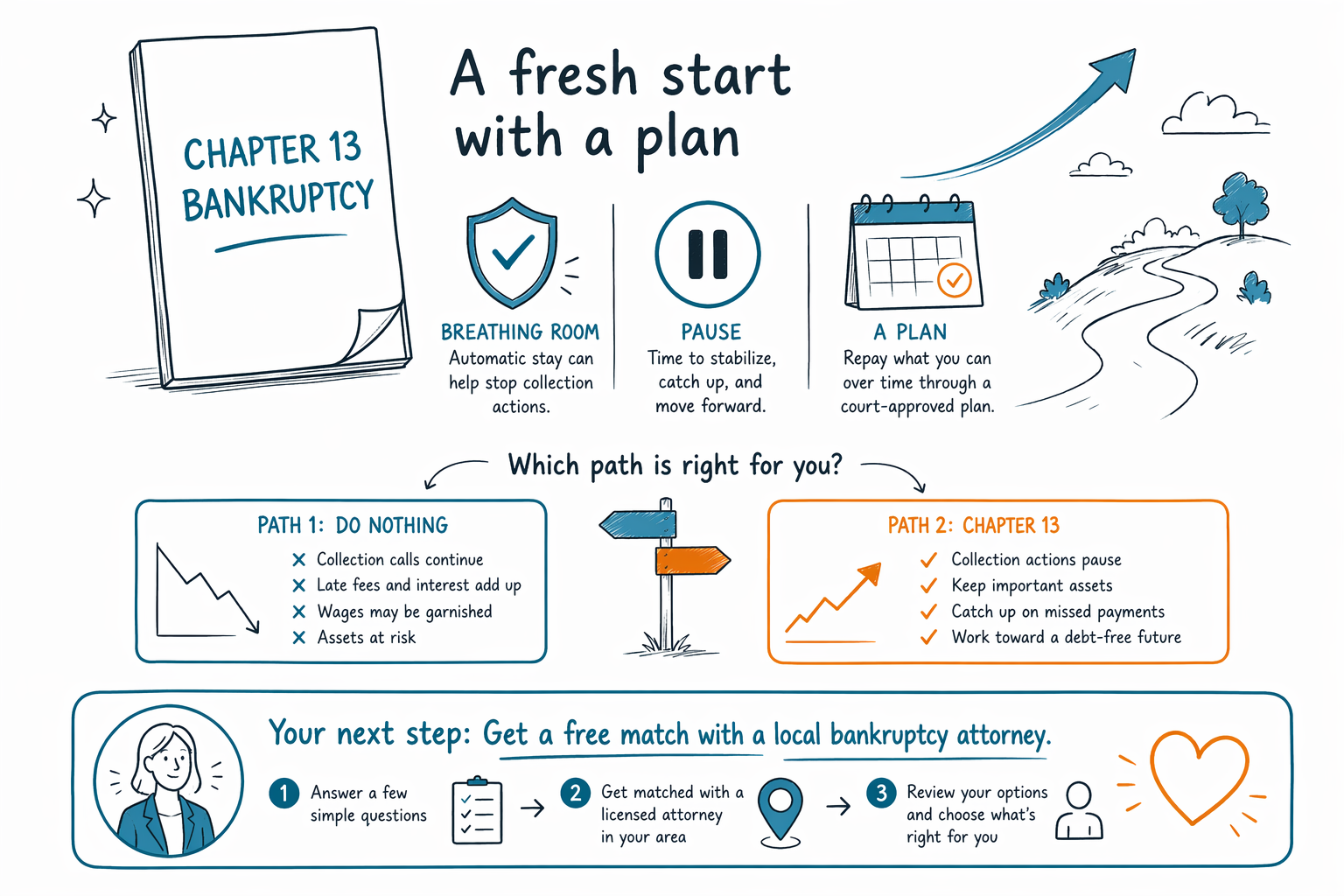
Chapter 13 is often called the “repayment plan” bankruptcy. Instead of selling property to pay creditors, it lets a person with regular income propose a monthly plan, usually for 3 to 5 years, to deal with debt in an organized way under court protection.
Many people look at Chapter 13 when they are behind on a mortgage, car loan, or certain taxes and want time to catch up. It can also help when someone earns too much for Chapter 7, has property they want to protect, or needs a way to stop a wage garnishment or foreclosure while working out a plan.
When a Chapter 13 case is filed, the automatic stay usually starts right away. That court protection pauses most collections, lawsuits, wage garnishments, and foreclosure activity while the case moves forward.
Chapter 13 is not the right fit for everyone. It requires a steady enough income to support both current living expenses and the plan payment, and the exact rules depend on your state, district, income, debts, and property.
What Chapter 13 can do — and what it cannot do
Chapter 13 can give you time. For many people, that is the biggest benefit. If you are behind on your mortgage, a Chapter 13 plan may let you spread those missed payments out over time while you keep making the regular monthly payment going forward. The same may be true for some car loan arrears and certain tax debts.
It may also help you keep property through exemptions and through the structure of the plan. Many people do keep their home and car in Chapter 13, but that depends on the facts of the case, the value of the property, loan terms, your income, and your local rules.
What Chapter 13 does not do is erase every debt automatically. Some debts usually survive bankruptcy, including most student loans, recent income taxes, child support, alimony, most court fines, and debts tied to fraud. Outcomes depend on the individual case.
It also does not remove the need to make payments. Chapter 13 is a serious long-term commitment. If plan payments are missed, the case can run into trouble, and protections can be lost.
Who Chapter 13 may fit
Chapter 13 may fit a person who has regular income and needs a structured way to catch up rather than a quick discharge. It is commonly discussed with people who are behind on a house payment, facing foreclosure, trying to stop a garnishment, or trying to protect property they might lose in another chapter.
It can also be an option for someone who does not qualify for Chapter 7 after the means test and income review, or for someone whose debts need more time and court supervision to sort out.
A Chapter 13 lawyer will usually look at your income, monthly budget, secured debts like a mortgage or car, priority debts like support or some taxes, and the property you own. Because exemptions and local practice vary by state and district, a licensed bankruptcy attorney in your area is the right person to tell you whether Chapter 13 is realistic.
CleanSlate Match is a free matching service, not a law firm, and not your lawyer. We can help you get connected with a licensed bankruptcy attorney near you for a real case review.
How the Chapter 13 process usually works
A typical Chapter 13 case starts with a consultation with a bankruptcy attorney. The lawyer reviews your general situation, explains whether Chapter 13 or another option may fit better, and talks through likely costs, timing, and risks. Bankruptcy law is federal, but exemptions and many practical rules vary by state and district.
If you decide to move forward, the case is prepared and filed with the bankruptcy court. Once the case is filed, the automatic stay usually goes into effect and pauses most collection activity. Then a Chapter 13 plan is proposed, showing how certain debts will be handled over 3 to 5 years.
The trustee, creditors, and judge may review the plan. Sometimes changes are needed before confirmation. During the case, you generally make monthly plan payments and stay current on any required ongoing obligations, such as current mortgage payments if your plan requires that.
A very simple version looks like this:
1. Meet with a licensed bankruptcy attorney.
2. Review your debts, income, property, and goals.
3. File the case and get the automatic stay.
4. Propose a 3- to 5-year repayment plan.
5. Make plan payments and follow court requirements.
6. If the case is completed successfully, receive the discharge available in your case.
What Chapter 13 usually costs
Chapter 13 usually costs more than Chapter 7 because it is more work and lasts much longer. Most consumer bankruptcy attorneys charge a flat fee for a standard Chapter 13 case, plus the court filing fee and a small required credit-counseling and debtor-education cost. These are ranges, not quotes, and the real number depends on the chapter, the complexity, and the district.
In many areas, attorney flat fees for a consumer Chapter 13 are often roughly in the $3,000 to $6,500 range for a more typical case, sometimes higher in more complex matters or higher-cost districts. The court filing fee is usually a few hundred dollars, and the required courses are often a small additional cost. Some attorneys allow part of their Chapter 13 fee to be paid through the plan, depending on local practice and the facts.
Costs can go up if the case involves business issues, multiple properties, tax problems, motions to stop or continue foreclosure, contested hearings, unusual assets, or plan changes after filing. Costs may be lower for a simpler case in a lower-cost district. The only way to know your likely price is to ask a local licensed attorney.
If you want more detail on bankruptcy pricing generally, see bankruptcy costs. And remember: CleanSlate Match is free for the person seeking help. Participating attorneys pay a flat fee to take part in the service.
Common mistakes to avoid when looking for Chapter 13 help
One common mistake is waiting too long. If a foreclosure sale, repossession, garnishment, or bank levy is close, time matters. Filing a case can trigger the automatic stay, but only after a real case is filed. Waiting until the last minute can limit your options.
Another mistake is assuming Chapter 13 fixes everything. It can be powerful, but it is not magic. You still need a workable budget and a plan payment you can realistically maintain. If someone promises that bankruptcy will erase all debt or guarantees a result, be careful.
It is also important to hire the right person. Confirm that the attorney is licensed in your state and ask whether they regularly handle consumer bankruptcy cases in your district. Ask what is included in the flat fee, what extra costs might come up, and what debts may not be discharged.
When you ask CleanSlate Match for help, we collect contact information and general intent only, such as your name, phone, optional email, state, preferred language, and a broad description of what is happening. We do not ask for a Social Security number, bank-account numbers, credit-card numbers, or detailed financial-account information. When you are ready, you can get matched for free with a licensed bankruptcy attorney near you.
Chapter 13 can give some people breathing room and a path to catch up, but the safest next step is a free match with a licensed local bankruptcy attorney who can review your real options.
Common questions
Can Chapter 13 stop foreclosure?
It often can pause a foreclosure right away through the automatic stay once the case is filed, and it may let you catch up on missed mortgage payments over time. But it does not guarantee you will keep the home; the outcome depends on your income, loan status, plan terms, and local rules.
Will Chapter 13 erase my credit cards and medical bills?
Some unsecured debts such as credit cards and medical bills may be discharged at the end of a successful Chapter 13 case, but not always in the same way for every person. Some debts usually survive, including most student loans, child support, alimony, many recent taxes, most court fines, and debts from fraud.
How long does Chapter 13 last?
Most Chapter 13 plans last 3 to 5 years. The exact length depends on your income, your plan, and court requirements in your case.
Can I keep my car in Chapter 13?
Many people do keep their car in Chapter 13, especially when the plan is used to catch up on missed payments or reorganize certain secured debt. Whether that works in your case depends on the loan, the value of the car, your budget, and local rules.
Do I need a lawyer for Chapter 13?
You are generally allowed to file on your own, but Chapter 13 is paperwork-heavy and rule-heavy, and local practice matters a lot. Most people are safer speaking with a licensed bankruptcy attorney in their area before deciding.
What does CleanSlate Match do?
CleanSlate Match is a free matching service, not a law firm and not your lawyer. We provide general educational information and help connect you with a licensed bankruptcy attorney near you; we do not file bankruptcy cases or give legal advice.