Guides
Can i keep my car in bankruptcy?
Maybe. Many people do keep their car in bankruptcy, but it depends on your state’s exemption rules, the value in the car, your loan, and whether you can afford the payments going forward.
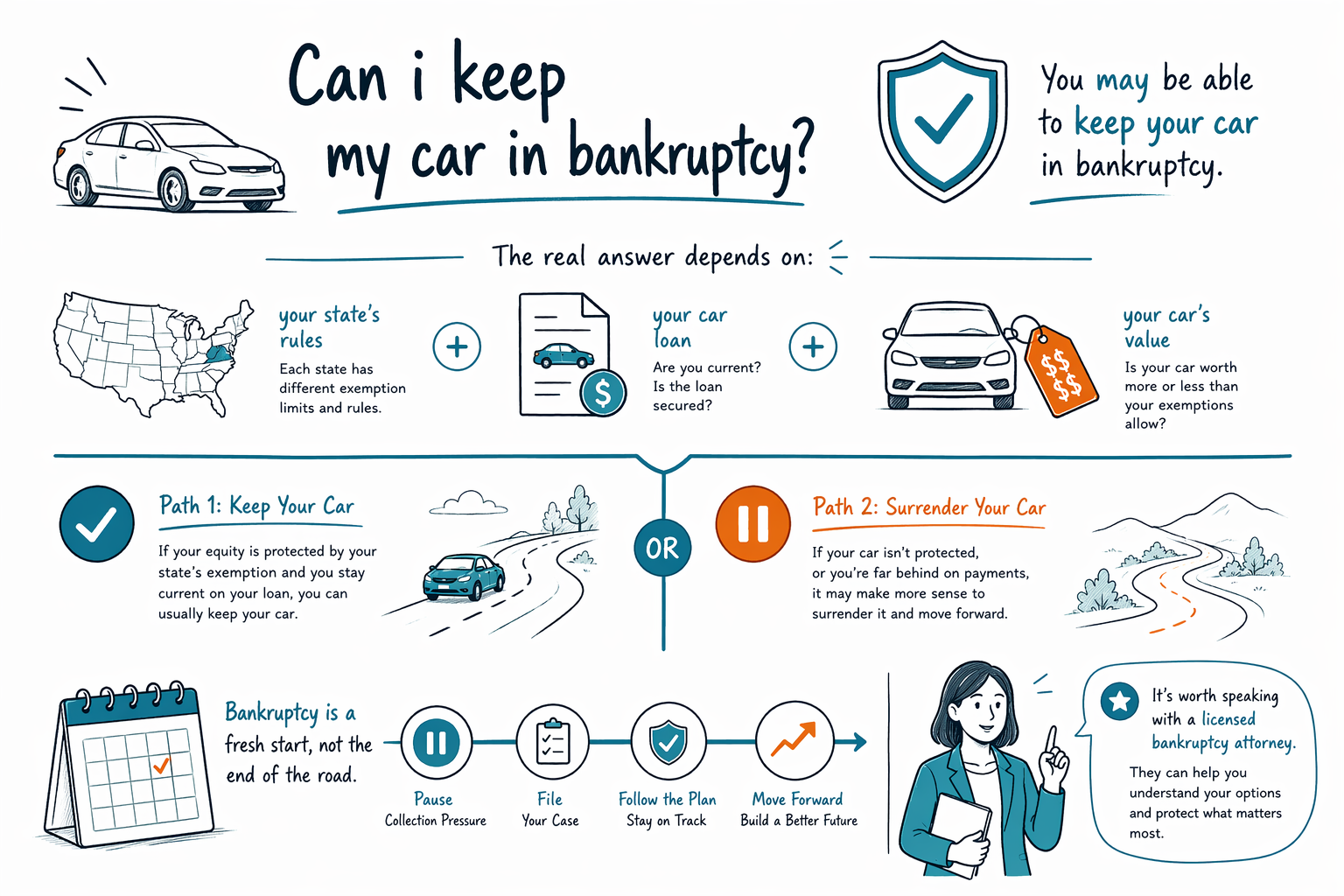
Short answer: yes, many people keep their car
A car is often one of the biggest worries in bankruptcy. The honest answer is that many people do keep their car, especially if they need it for work, school, medical care, or family life.
Whether you can keep it depends on a few things: whether you own it outright or still have a loan, how much equity you have, what exemption laws apply in your state, and which chapter you file under. Bankruptcy rules vary by state and judicial district, and the details matter.
Bankruptcy can help with some debts, but it does not erase every kind of debt. Some debts usually survive, including most student loans, recent income taxes, child support and alimony, most court fines, and debts related to fraud. A licensed bankruptcy attorney in your area can explain how your car and your other debts may be treated in your specific case.
What matters most: loan, value, and equity
Start with three basic questions. First: do you have a car loan? Second: what is the car worth today? Third: if there is a loan, how much do you still owe?
The difference between the car’s current value and the loan balance is called equity. Example: if your car is worth $8,000 and you owe $6,000, you have about $2,000 in equity. If your state’s vehicle exemption covers that amount, you may be able to keep the car as long as you also handle the loan correctly.
If you own the car free and clear, the main question is whether an exemption protects its value. If you are still making payments, the lender’s lien usually survives bankruptcy unless the law provides a specific way to change that treatment. That is why both exemption rules and loan rules matter.
How Chapter 7 and Chapter 13 can affect your car
In Chapter 7, people often keep a car if the equity is protected by an exemption and they stay current on any car loan they choose to keep. If the equity is not fully protected, there can be a risk that the trustee may want the non-exempt value for creditors. In some cases, people decide to surrender a car they cannot afford and discharge the related unsecured balance if the law allows.
In Chapter 13, there is often more flexibility for keeping a car, especially if you are behind on payments but have enough income for a repayment plan. A Chapter 13 plan may let you catch up over time. Some car loans may also be treated differently depending on when the loan was taken out and other facts.
The right chapter depends on your full picture, not just the car. You can learn more in our guides and overview of chapters, but the safest next step is to speak with a licensed bankruptcy attorney where you live.
If you still owe on the car
If there is a car loan, keeping the car usually means keeping up with the loan in some form. In Chapter 7, that may mean staying current and following the process your attorney advises for your district. In Chapter 13, it may mean paying through a court-approved plan.
If you are already behind, bankruptcy may help because the automatic stay usually stops most collection actions as soon as a case is filed. That can pause repossession efforts in many situations, and it can also stop most wage garnishments, lawsuits, and foreclosure activity while the case moves forward. But the stay has limits, and creditors can sometimes ask the court for permission to continue.
If the payment is simply too high for your budget, bankruptcy does not magically make a car affordable. Sometimes the best financial choice is to surrender the vehicle and look for a less expensive option after getting advice. A lawyer can help you compare those paths honestly.
If you own the car outright
If your car is paid off, the main issue is usually the exemption amount available under the law that applies to you. Exemptions are laws that protect certain property from being taken to pay creditors. Many states have a motor-vehicle exemption, and some people may also use part of another exemption, depending on the state and the facts.
This is where small details can change the answer. The same car might be fully protected in one state but partly unprotected in another. Some states let filers choose between exemption systems, while others do not. Because rules vary by state and district, no online guide can tell you for sure whether your car is safe.
A licensed bankruptcy attorney can estimate the car’s value, review the title and loan information, and explain whether the exemption likely protects it.
Practical next steps, cost, and how CleanSlate Match works
If you are worried about losing your car, try to gather a few basic facts before you talk with a lawyer:
- Your state.
- Whether the car is paid off or financed.
- About how much the car is worth today.
- About how much you still owe, if anything.
- Whether you are current or behind on payments.
- Whether the car is necessary for work, school, medical care, or family needs.
Most consumer bankruptcy attorneys charge a flat fee, plus the court filing fee and a small required credit-counseling fee. Very general ranges many people see are roughly $1,000 to $2,500 in attorney flat fees for a typical Chapter 7, and about $3,000 to $6,500 or more for a typical Chapter 13, depending on the district, complexity, and local practice. Court filing fees are separate and are commonly a few hundred dollars. These are not quotes, and the real number depends on your chapter, your car issues, your income and assets, and where you file.
CleanSlate Match is a free matching service, not a law firm and not your lawyer. We do not file bankruptcy and we do not create an attorney-client relationship. We only collect contact information and general intent, such as your name, phone, optional email, state, preferred language, and a general sense of your situation, so we can help connect you with a licensed bankruptcy attorney near you. We do not ask for your Social Security number, bank-account numbers, credit-card numbers, or other financial-account details.
If you want, you can get matched for free with a licensed bankruptcy attorney near you. It is also smart to confirm that attorney’s bar license in your state before hiring them.
You may be able to keep your car in bankruptcy, but the real answer depends on your state’s rules, your car loan, and your car’s value, so it is worth speaking with a licensed bankruptcy attorney.
Common questions
Will bankruptcy automatically take my car away?
No. Bankruptcy does not automatically mean you lose your car. Many people keep their car, but the outcome depends on equity, exemptions, the loan, the chapter filed, and the rules in their state and district.
Can I keep my car if I am behind on payments?
Sometimes, yes. Chapter 13 may give some people a way to catch up over time, and the automatic stay usually stops most collection actions once a case is filed. But there are limits, and a lender may ask the court for permission to continue, so get legal advice quickly.
What if my car is paid off?
Then the main question is usually whether an exemption protects the car’s value. If the value is fully protected under the exemption rules that apply to you, you may be able to keep it.
Can bankruptcy erase my car loan?
Bankruptcy may help with personal liability on some debts, but a lender’s lien on the car usually still matters. Whether you can keep the car, surrender it, or change how the loan is treated depends on the chapter and the facts of your case.
What debts usually are not erased in bankruptcy?
Some debts usually survive, including most student loans, recent income taxes, child support and alimony, most court fines, and debts from fraud. Outcomes depend on the individual case.
How do I find a lawyer if English is not my first language?
CleanSlate Match may be able to help connect you, free, with a licensed bankruptcy attorney near you and note your preferred language. We are not a law firm or a lawyer, and the attorney should explain fees, options, and local rules directly to you.
Related help
A plain-language comparison of the two main consumer bankruptcies, when each makes sense, and how a lawyer helps you decide.
Open → What Debt Bankruptcy Can and Can't EraseWhich debts bankruptcy wipes out, which ones survive (like most student loans and child support), and why it matters.
Open → Will I Lose My House or Car in Bankruptcy?How exemptions and the two chapters affect your home and car — and why many people keep both.
Open →