Guides
Does bankruptcy clear tax debt?
It may clear some tax debt, but it does not automatically erase all taxes. The answer depends on the type of tax, how old it is, and your situation—so the right next step is a quick consult with a licensed bankruptcy attorney.
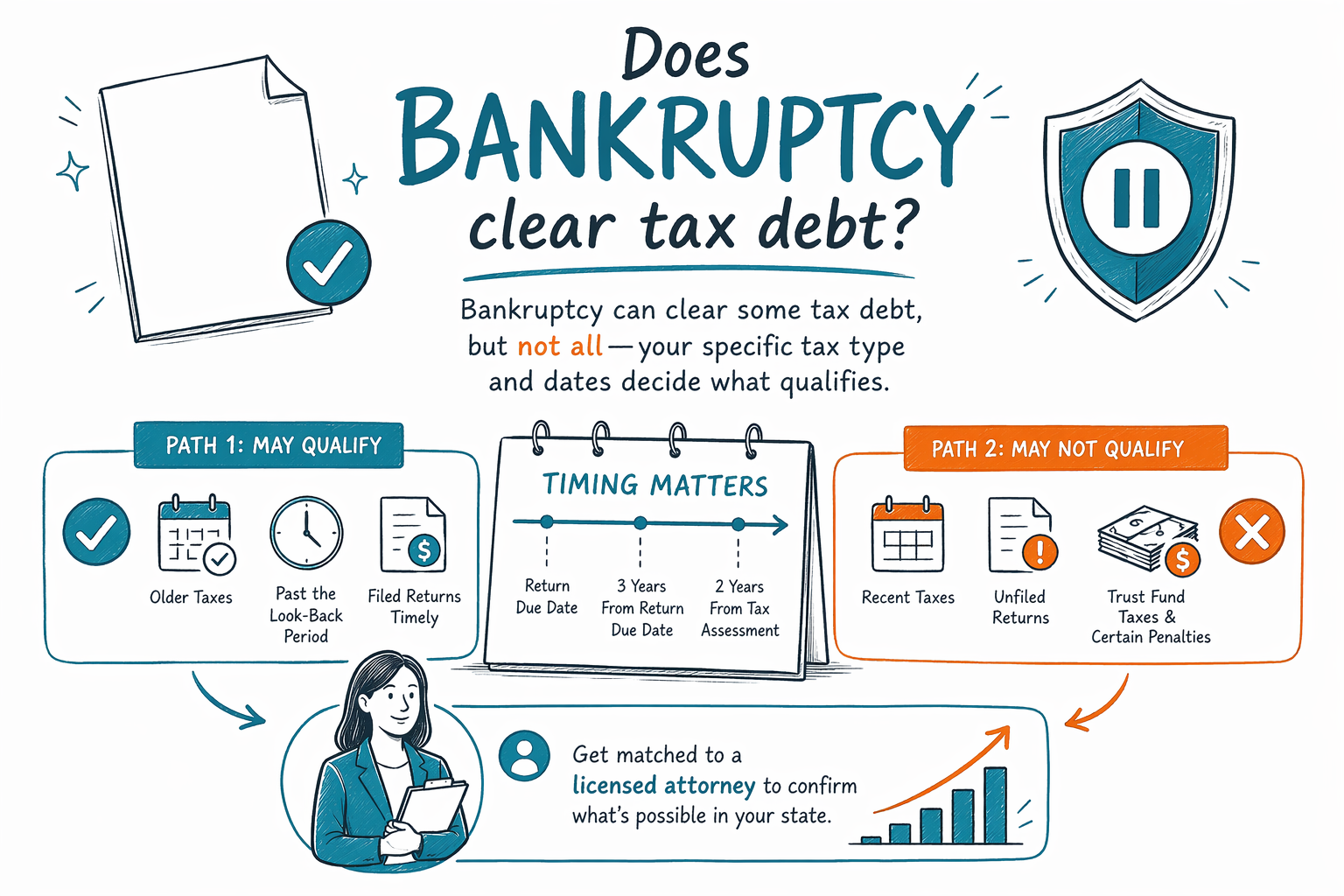
Quick answer: bankruptcy may discharge some—but not all—taxes
Bankruptcy can sometimes discharge certain qualifying tax debts. But many tax debts do not qualify, especially if they’re recent, you filed late, or there are issues like nonpayment after fraud or willful tax violations.
The details matter. A licensed bankruptcy attorney can review your tax type (federal, state, payroll/withholding), dates (when the return was filed and when the tax was assessed), and whether any penalties or interest are involved—then explain what could be dischargeable in your case.
Because bankruptcy rules and tax exceptions vary by state and by federal judicial district, your outcome can be different depending on where you live.
- Some older, properly filed tax debts may be dischargeable (in the right circumstances).
- Some taxes often survive bankruptcy, even if other debts are cleared.
What usually affects whether tax debt can be cleared
In bankruptcy, tax debt is usually evaluated based on “eligibility” rules. These commonly include whether the tax return was filed on time, how long ago the tax return was filed, and how long ago the taxes were assessed.
Also, certain tax debts are treated differently—like payroll taxes (trust fund taxes) or taxes connected to wrongdoing. If penalties are tied to non-dischargeable tax obligations, you may find that the related amount is not fully removed.
This is why it’s risky to rely on a general “yes/no” answer. A short, careful review of your tax documents and dates is often the difference between relief and disappointment.
- Age of the tax and the filing date of the return are often key.
- Payroll/withholding taxes and taxes tied to fraud can be harder to discharge.
Chapter 7 vs. Chapter 13 for tax debt
Chapter 7 and Chapter 13 work differently.
In Chapter 7, many eligible debts are discharged after the bankruptcy process is completed, but taxes still have to meet discharge rules. In Chapter 13, you typically make payments under a court-approved repayment plan for 3–5 years, and some tax debts may be treated through the plan—while other taxes may need to be paid in full or partially, depending on eligibility.
Either way, your attorney will explain which taxes could be discharged and which may need to be paid, and how this differs in your district and state.
- Chapter 7 focuses on discharge—some taxes may qualify, others may not.
- Chapter 13 can restructure payments—but non-qualifying tax debts may still need payment.
Important limits: taxes and other common “non-dischargeable” debts
Bankruptcy is not a magic erase button. Even when bankruptcy can reduce or eliminate debts, some obligations often survive.
Many people are surprised to learn that some debts usually remain, including most student loans, recent income taxes, child support or alimony, most court fines, and debts involving fraud or certain misconduct. Tax debt can fall into either category depending on its details.
Your attorney can help you confirm what is likely to be discharged in your specific case—and what you should expect to keep paying after bankruptcy.
- Some recent taxes often do not qualify for discharge.
- Some tax debts connected to trust fund payroll or wrongdoing may not be dischargeable.
Can bankruptcy stop collections, wage garnishment, or lawsuits for tax debt?
Often, once a bankruptcy case is filed, the “automatic stay” can pause many collection actions. That can include stopping many lawsuits, collection calls, and some garnishments while the case is pending.
However, the rules can be more complex for certain government collection efforts, and there may be exceptions depending on the type of tax and what steps were already taken. That’s another reason to get legal help quickly—especially if you’re facing a deadline, garnishment, or a pending hearing.
Even when some taxes may not be discharged, the stay can still create breathing room to organize your next steps with the help of a licensed bankruptcy attorney.
- Filing often triggers an automatic stay that can pause many collections.
- Exceptions may apply, so confirm details with an attorney.
Get matched with a licensed bankruptcy attorney (free to you)
CleanSlate Match is a FREE matching service. We’re not a law firm, and we don’t file bankruptcy or represent you. We connect you with a licensed bankruptcy attorney near you for a case review.
To get matched, share your contact info and a general sense of what’s going on (for example, whether you’re worried about federal or state taxes, and whether you’re facing garnishment or a lawsuit). We do not ask for Social Security numbers or bank-account information.
After you’re matched, ask the attorney the right questions: what type of tax debt you have, whether it appears dischargeable, whether Chapter 7 or Chapter 13 makes more sense, and what outcomes are realistic for your state and district. Then confirm the attorney’s bar license before you move forward.
- Start here: [get matched](/get-matched/).
- Learn the basics: [chapters](/chapters/), [guides](/guides/).
Bankruptcy can clear some tax debt, but not all—your specific tax type and dates decide what qualifies, so get matched to a licensed attorney to confirm what’s possible in your state.
Common questions
Does bankruptcy always clear tax debt?
No. Bankruptcy may clear some tax debts, but it does not automatically erase all tax debt. Eligibility depends on the tax type, dates (return filing and assessment), and other factors—so you need a case-specific review.
Will I still owe taxes after Chapter 7?
Possibly. Some taxes are commonly not dischargeable, and the rest must meet eligibility rules. A bankruptcy attorney can tell you which parts are likely to remain based on your dates and the type of tax.
Can I stop the IRS or my state from garnishing my wages by filing bankruptcy?
Filing often triggers an automatic stay that can pause many collection actions. But there can be exceptions and timing matters, especially for certain government actions, so it’s important to confirm quickly with a licensed attorney.
If my taxes can’t be discharged, is bankruptcy still worth it?
For some people, yes. Even when taxes can’t be fully discharged, bankruptcy can sometimes create structured repayment options (especially in Chapter 13) and may still pause certain collections while the case proceeds.
Related help
A plain-language comparison of the two main consumer bankruptcies, when each makes sense, and how a lawyer helps you decide.
Open → What Debt Bankruptcy Can and Can't EraseWhich debts bankruptcy wipes out, which ones survive (like most student loans and child support), and why it matters.
Open → Will I Lose My House or Car in Bankruptcy?How exemptions and the two chapters affect your home and car — and why many people keep both.
Open →